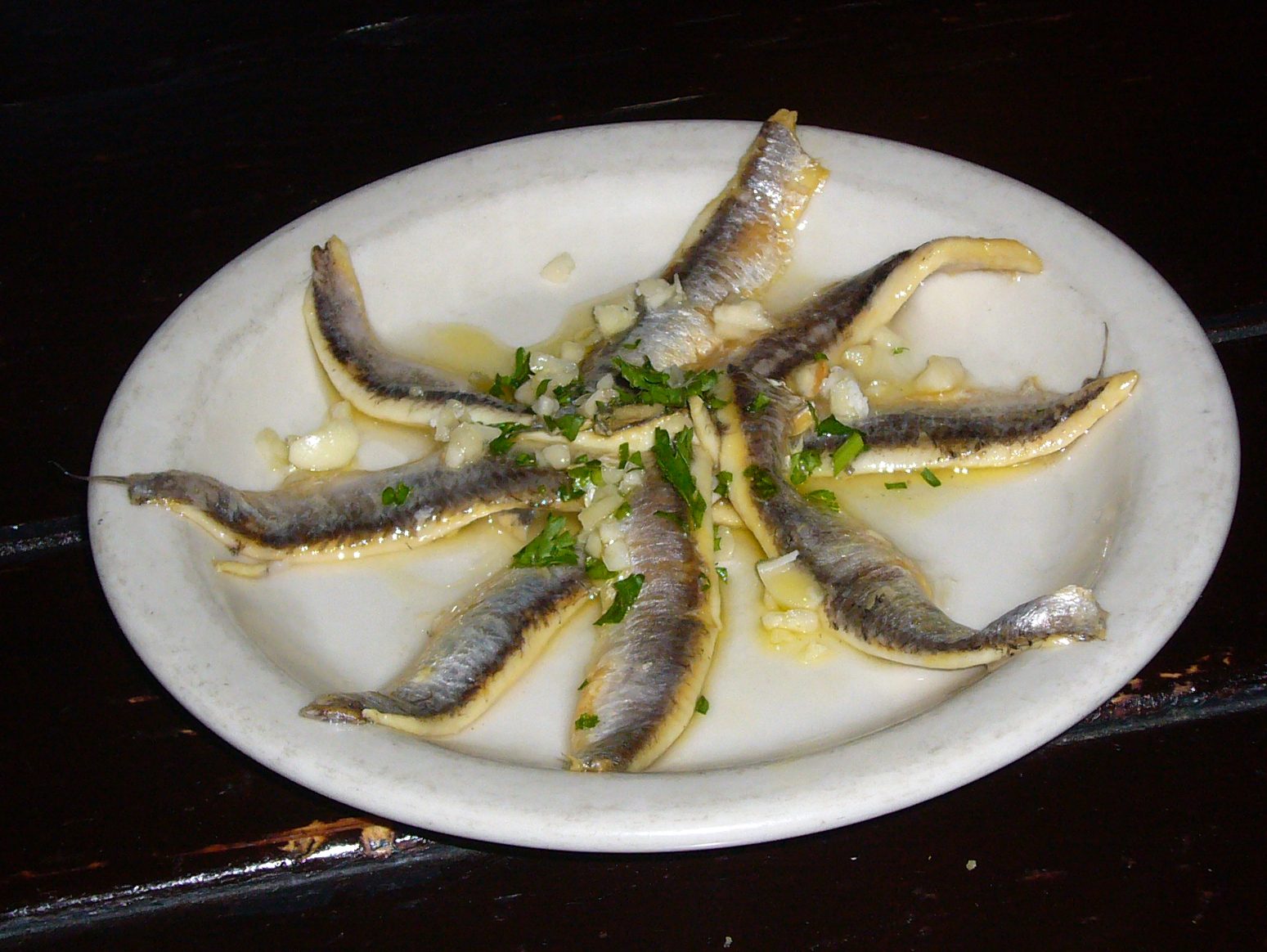
Boquerones en Vinagre (Vinegar-Cured Fresh Anchovies)
Declassified 22 August 2026
Threat assessment
- 1 No contact Nobody is in danger. Least of all the locals.
- 2 Light resistance A warmth. You mention it. Nobody responds.
- 3 Engaged You are sweating. No one else at the table is sweating.
- 4 Taking fire You have stopped talking. A child has taken your portion.
- 5 Operative down Extraction required. Locals describe this one as "not spicy".
Boquerones en vinagre are fresh anchovy fillets turned firm and chalk-white by nothing but salt and vinegar, then dressed in olive oil, garlic and parsley. They belong to the vermouth hour in Málaga and to every old tavern counter in Madrid, where they sit next to the olives as the cold, raw, cheap counterpart to jamón. A good one is white the whole way through with no grey stripe left in the middle, still yielding rather than chalky, and tastes of anchovy and good oil first and vinegar second. The freezing step is not a suggestion: it is the only thing that makes raw anchovy safe to eat, and it needs five days in a home freezer, not the overnight most drafts claim. Photo: Kent Wang (CC BY-SA 2.0), via Wikimedia Commons.
// SUPPLY LIST
SCALE:
| AMT | UNIT | ITEM |
|---|---|---|
| 500 | g | Fresh whole anchovies (boquerones), 10-12 cm, clear-eyed and stiff, unfilleted - about 45 fish |
| 400 | g | Ice cubes, for the purging baths (three baths of about 1 litre of very cold water each) |
| 300 | ml | White wine vinegar (vinagre de vino blanco), 6% acidity, or Vinagre de Jerez at 7% |
| 100 | ml | Cold water, to dilute the cure |
| 15 | g | Fine sea salt, for the cure |
| 3 | clove | Garlic, peeled and sliced paper-thin lengthways |
| 3 | tbsp | Flat-leaf parsley, leaves only, finely chopped |
| 150 | ml | Extra virgin olive oil, Andalusian Picual or Hojiblanca, for covering |
| Flaky sea salt, to finish | ||
| Green olives (manzanilla or gordal), to serve | ||
| Picos or regañás (dry Andalusian breadsticks), to serve |
// OPERATIONS
- 1 Buy anchovies that are genuinely fresh - clear domed eyes, stiff bodies, unbroken silver flanks, a smell of clean sea; a soft belly or a torn, bloody gut cavity means the fish will disintegrate in the cure. Working over a bowl set on ice, pinch each head between thumb and forefinger, bend it back towards the spine and pull down and away so head and guts come out together, open the belly to the tail with your thumbnail, then slide your thumb under the backbone from the head end and lift it out in one piece, snapping it off at the tail. Use fingers, never a knife - a blade shreds flesh this soft - and leave the two fillets joined at the tail, Málaga style, so each fish gives you one butterflied fillet. Expect 25-30 minutes, and about 45 butterflied fillets weighing roughly 250 g in total from 500 g of whole fish; if you are getting much less than half the starting weight back, you are tearing flesh away with the backbone.
- 2 Slip the fillets into a bowl of about 1 litre of very cold water with a third of the ice and refrigerate for 25 minutes, draining and refilling twice more with fresh cold water and ice, until the water stays clear instead of clouding pink. This purge is what makes them white and clean-tasting rather than grey and metallic, and skipping it is the commonest reason home boquerones look dull. Drain in a colander for 5 minutes, then pat both sides dry with kitchen paper - fillets that go into the freezer wet knit together into a block you cannot separate without tearing.
- 3 Lay the fillets flat and barely touching on a baking-paper-lined tray, wrap the whole tray airtight and freeze for a minimum of 5 full days. Five days is what Spanish food-safety guidance (AESAN) sets for any domestic freezer rated three stars or better, meaning it holds -18°C (0°F) or colder; the 24 hours at -20°C (-4°F) written into EU law is a commercial blast-freezing figure that assumes the temperature is verified in the centre of each fish, which no home freezer lets you do, so do not borrow it. If your freezer is not three-star, do not improvise - buy anchovies already frozen at sea. This is the one step with nothing to do with flavour: it kills anisakis larvae, and vinegar, salt, lemon juice and a 'sushi-grade' label do not - only freezing, or cooking the fish right through to 60°C (140°F) for at least a minute, does - so never cure anchovies you have not frozen.
- 4 Thaw the still-wrapped tray in the fridge at 4°C (39°F) for 8-12 hours or overnight, standing the fillets on a rack over a tray so meltwater drains away from them. Never thaw at room temperature or under running water: the flesh goes slack and waterlogged and no amount of curing will firm it again. Blot both sides dry once more before they go into the vinegar - the freezing has already opened up the flesh, so it will drink the cure faster than fresh fish would.
- 5 In a shallow glass, ceramic or stainless-steel dish about 20 x 15 cm, stir the 15 g of fine sea salt into the 300 ml of vinegar and 100 ml of cold water until fully dissolved - never aluminium or bare cast iron, which the acid attacks and which leaves the fish tasting of metal. Lay the fillets skin-side up in no more than two even layers, pour the liquid over so every fillet is submerged under about a centimetre of it, and press a small plate on top if any float; if the liquid does not cover, move to a narrower dish rather than topping up with water, which would weaken the cure. Refrigerate at 4°C (39°F).
- 6 Cure for 3 to 4 hours for fillets off 10-12 cm fish, checking from 3 hours: lift the thickest fillet out and look at it edge on, and it should be opaque chalk-white the whole way through with no translucent grey line left down the centre. Pull them the moment that line disappears - under-cured fillets stay floppy and taste raw, while anything much past 6 hours turns cottony, crumbles when lifted and tastes of nothing but acid. Sherry vinegar at 7% and previously frozen fillets both work faster, so start looking at 2 hours 30; and plenty of Málaga households use the vinegar neat with no water at all, which is entirely traditional, in which case start checking at 2 hours.
- 7 Lift the fillets out with your fingers and drain them in a single layer on a rack or kitchen paper for 10 minutes, blotting the tops. Do not rinse them under the tap however tempting it looks - the water strips out the salt and leaves them tasting sour and hollow instead of of anchovy. Throw the vinegar away; it is spent and cloudy with fish protein.
- 8 Layer the fillets skin-side down in a shallow container just big enough to hold them, scattering each layer with the paper-thin garlic and two-thirds of the parsley, then pour over the 150 ml of extra virgin olive oil so it covers them completely, tilting the dish to release trapped air. Keep the container snug - 150 ml covers 250 g of fillets in a 15 x 10 cm box but will only puddle in a wide dish, and any fillet left standing proud of the oil will dry and darken overnight. Use an oil you would happily dip bread into - a Picual or Hojiblanca from Andalusia - because from this point the oil is half the dish and a flat supermarket blend will flatten everything with it.
- 9 Cover and refrigerate for at least 2 hours and ideally overnight, a full 12 hours: the oil takes on the garlic, the vinegar edge settles back and the texture goes from squeaky to silky. Keep them at 4°C (39°F) and eat within 3 days - raw garlic sitting in oil must never be stored at room temperature, and the fillets soften and go musty-tasting past that anyway.
- 10 Take the dish out of the fridge 20-30 minutes before serving so the chilled oil clears from cloudy to bright and the fish comes up to about 16°C (61°F), the point at which it actually tastes of something. Lay seven or eight butterflied fillets per person on a cold plate - the 500 g of fish gives about 45, a proper tapa portion of roughly 40 g each rather than a main course - spoon over some of the garlicky oil, finish with a few flakes of sea salt and the last of the parsley, and serve with picos or regañás and green olives, alongside a very cold vermut de grifo or a chilled fino or manzanilla; in Madrid the same plate arrives with a bowl of potato crisps beside it and nobody apologises for it.