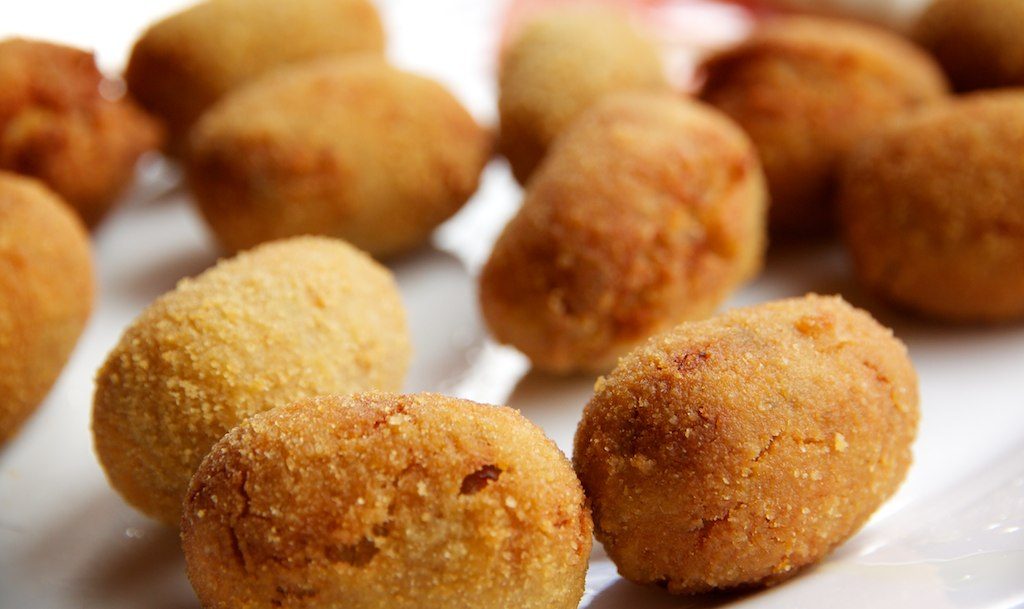
Ham Croquettes (Croquetas de Jamón)
Declassified 22 August 2026
Threat assessment
- 1 No contact Nobody is in danger. Least of all the locals.
- 2 Light resistance A warmth. You mention it. Nobody responds.
- 3 Engaged You are sweating. No one else at the table is sweating.
- 4 Taking fire You have stopped talking. A child has taken your portion.
- 5 Operative down Extraction required. Locals describe this one as "not spicy".
Croquetas de jamón are small fried barrels of very thick, ham-flavoured béchamel, set overnight until it can be cut, then breaded and dropped into hot oil so the shell crisps before the inside melts. They are cooked in homes and bars across Spain, most densely in Madrid, Castile and Andalusia, and a bar's kitchen is generally judged on them. A good one has a thin, evenly gold crust that gives way to a filling that flows rather than crumbles, tastes clearly of cured ham rather than of flour, and has no lumps and no chalkiness. Everything rests on two things: cooking the béchamel far longer than feels necessary, and chilling it properly before you shape it. Photo: Jonathan Pincas from Leon, Spain (CC BY 2.0), via Wikimedia Commons.
// SUPPLY LIST
SCALE:
| AMT | UNIT | ITEM |
|---|---|---|
| 1 | l | Whole milk, full fat, cold |
| 1 | piece | Jamón serrano or ibérico bone, or the hard dried end trimmings of the ham |
| 1 | Bay leaf, dried | |
| 50 | ml | Olive oil, mild or a soft extra virgin (not a peppery, bitter one, which fights the ham) |
| 60 | g | Unsalted butter |
| 100 | g | Onion, white or brown, peeled and chopped to a 2-3 mm dice |
| 200 | g | Jamón serrano, cut into 3-4 mm dice, fat included and not trimmed off |
| 100 | g | Plain white wheat flour, for the béchamel |
| 0.25 | tsp | Nutmeg, freshly grated |
| 0.25 | tsp | White pepper, ground |
| Fine sea salt, to taste | ||
| 100 | g | Plain white wheat flour, for coating |
| 4 | Eggs, large, beaten with a pinch of salt | |
| 250 | g | Fine dry breadcrumbs (pan rallado), not panko |
| 1.5 | l | Mild olive oil or sunflower oil, for deep frying |
// OPERATIONS
- 1 Put the 1 litre of cold whole milk in a saucepan with the jamón bone or the hard dried ham trimmings and the bay leaf and bring it to just under a simmer over medium heat, meaning small bubbles at the rim and about 85°C/185°F, never a rolling boil, which catches milk solids on the base and gives the whole batch a scorched edge; cover, take it off the heat, leave it to infuse 20 minutes, then strain out the bone and bay and keep the milk hot at around 60°C/140°F, because warm milk slips into the roux smoothly while fridge-cold milk seizes it into lumps.
- 2 In a heavy-based 24 cm saucepan or deep sauté pan (a thin pan will scorch the béchamel later), warm the 50 ml olive oil with the 60 g butter over low-medium heat until the butter foams but has taken no colour, then add the 100 g finely diced onion with a good pinch of salt and cook 10-12 minutes, stirring often, until it is completely translucent and collapsed and has no colour at all; browning here turns the béchamel beige and sweet, and any onion piece larger than 3 mm will read as a lump in the finished croqueta.
- 3 Add the 200 g diced jamón, fat and all, and stir for 2 minutes over low heat until the fat turns glassy and the pan smells strongly of ham, then stop, because jamón fried until crisp goes leathery and stays chewy inside the croqueta no matter how long the béchamel cooks afterwards.
- 4 Rain in the 100 g béchamel flour and stir constantly over low heat for a full 3 minutes, until the paste has gone from white to pale sand and smells of toasted biscuit rather than raw flour; this is the step people rush, and the flour has to lose its raw smell now, while it is still surrounded by fat and can actually toast — flour that goes in raw tastes of paste however long the sauce simmers afterwards.
- 5 Take the pan off the heat and add the hot infused milk about 150 ml at a time, beating each addition completely smooth with a whisk before the next goes in and switching to a wooden spoon once the diced ham begins clogging the wires; the first two additions will seize into a stiff, claggy paste and that is exactly right, and pouring the milk in faster to make it look better is the single most reliable way to get lumps.
- 6 Return the pan to low heat and cook 25-30 minutes, stirring continuously with a wooden spoon or silicone spatula and scraping the base and the corners on every stroke so nothing sits still and catches; it is ready when it has reduced enough to pull away from the sides in one glossy mass and a spoon dragged across the base leaves a clean channel that closes over slowly, in about 2 seconds, which for these quantities means roughly 1.2 kg of masa left in the pan — if it ever bubbles hard, drop the heat immediately, because one scorched patch flavours the whole batch, and if it still slumps flat it is not reduced and will not cut.
- 7 Off the heat, beat in the 1/4 tsp grated nutmeg and 1/4 tsp white pepper, then taste and add fine salt until it tastes a shade saltier than seems comfortable, because this will be eaten cold-set inside a bland crumb coat and cold food reads as under-seasoned; how much salt it takes depends entirely on how salty your jamón is, so taste rather than measure.
- 8 Scrape the mixture into a shallow tray or dish of about 20 x 20 cm, where 1.2 kg of masa will sit 2.5-3 cm deep, rap the tray down twice on the counter to level it and knock out air pockets, then press cling film flat onto the entire surface with no gaps, since exposed béchamel forms a rubbery skin within minutes and that skin shows up as tough strings inside the croquetas; cool 30 minutes on the counter, then refrigerate at least 8 hours and preferably overnight, and do not shortcut this in the freezer — an hour in the freezer sets the outer centimetre and leaves the middle liquid, and those are the croquetas that split and empty themselves into the oil.
- 9 Line up three shallow bowls holding the 100 g coating flour, the 4 beaten eggs and the 250 g fine breadcrumbs, then cut the set béchamel with a lightly oiled knife into about 40 pieces of roughly 30 g each — a 20 x 20 cm slab divides cleanly into a 5 x 8 grid, so pieces about 4 x 2.5 cm — and roll each between lightly floured palms into a barrel about 5 cm long and 2.5 cm thick, which comes out at six or seven croquetas a head; work six at a time and put the tray back in the fridge the moment the mixture starts sticking, because warm hands are what make them impossible to shape.
- 10 Roll each barrel in the flour and pat off every trace of excess, as a thick flour layer bakes into a pale powdery seam, turn it through the beaten egg and let the surplus drain back, then press and roll it through the breadcrumbs and close the two ends deliberately with your fingers; hold each one up and look for bald patches, because a single unsealed spot is exactly where it will burst.
- 11 Lay the breaded croquetas on a tray in a single layer, not touching, and refrigerate 30 minutes and up to 24 hours so the crumb dries onto the egg and forms a sealed shell that feels dry and papery rather than tacky; skipping this second chill is the most common reason home croquetas leak.
- 12 Heat at least 5 cm of mild olive or sunflower oil in a deep, narrow pan about 20 cm across to 180°C/356°F, at which a cube of bread browns in about 40 seconds, and fry only 4 or 5 croquetas at a time, turning once, for 60-90 seconds until they are an even deep gold the colour of a hazelnut shell; forty croquetas means eight to ten batches, so keep a thermometer in the oil, because crowding the pan drops it below 170°C/338°F and at that temperature the shell softens instead of setting and the croquetas split.
- 13 Lift them out with a slotted spoon onto a wire rack set over kitchen paper rather than straight onto the paper, which steams the underside soft, and let the oil climb back to 180°C/356°F before the next batch goes in; hold finished batches on the rack in a 100°C/212°F oven for up to 15 minutes if you are frying for a whole table, and rest each croqueta 3 minutes before eating, both because the centre comes out above 90°C/194°F and will scald and because the filling needs that moment to settle from liquid into properly molten.
- 14 Serve them hot on a warm plate with nothing on them, since croquetas de jamón are not dipped in alioli or squeezed with lemon in Spain and a good one does not need it, alongside a cold caña of beer or a chilled fino or manzanilla and perhaps a saucer of olives; anything you are not frying today should be frozen breaded and raw in a single layer on a tray, then bagged, and fried straight from frozen at 170°C/338°F for 4-5 minutes, which is what Spanish home cooks do and costs the croqueta nothing.