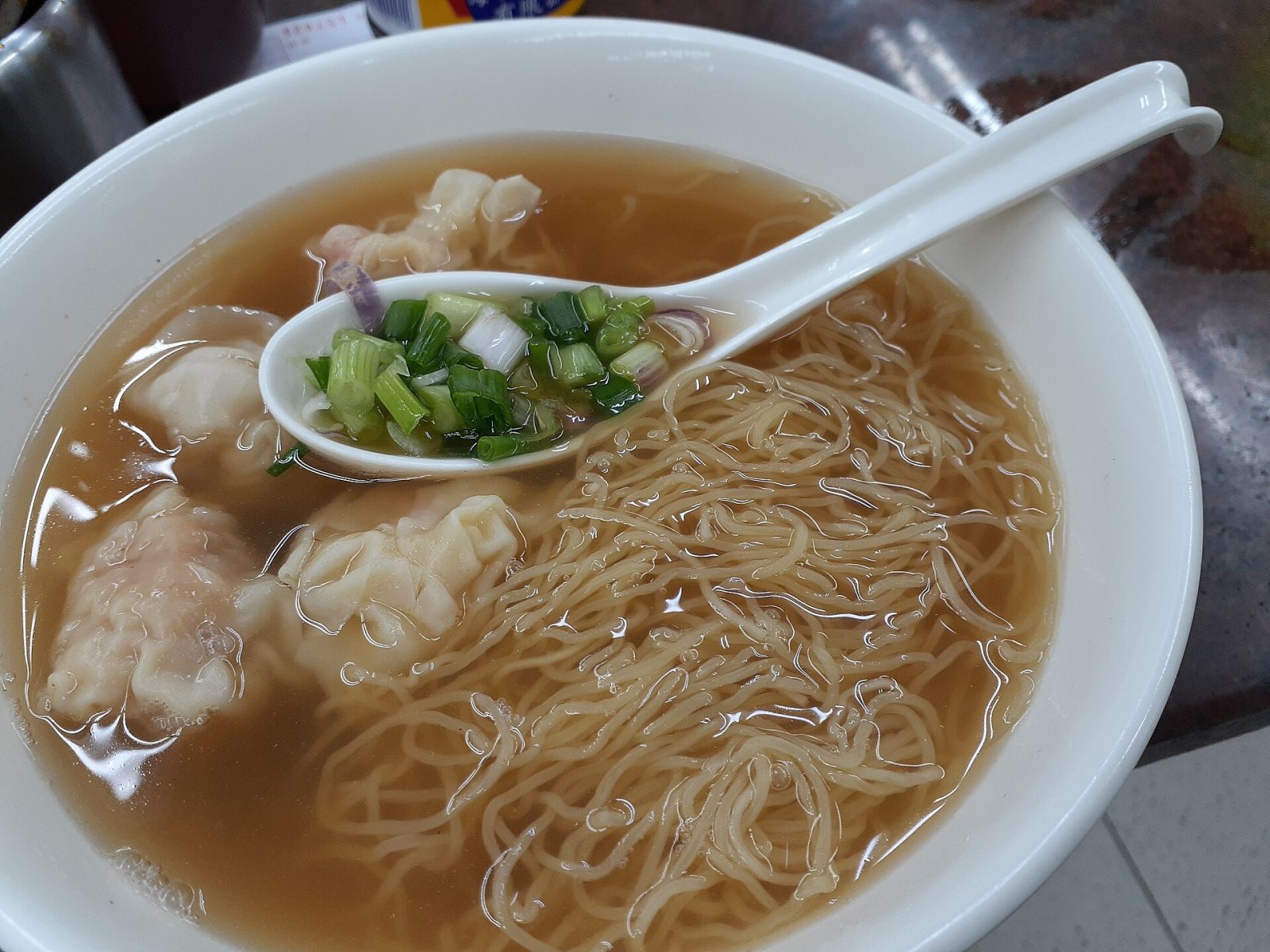
Hong Kong Wonton Noodle Soup (雲吞麵)
Declassified 22 August 2026
Threat assessment
- 1 No contact Nobody is in danger. Least of all the locals.
- 2 Light resistance A warmth. You mention it. Nobody responds.
- 3 Engaged You are sweating. No one else at the table is sweating.
- 4 Taking fire You have stopped talking. A child has taken your portion.
- 5 Operative down Extraction required. Locals describe this one as "not spicy".
Wantan mein is the small bowl Hongkongers judge a noodle shop by: five or six prawn-and-pork wontons sitting at the bottom, a broth built on toasted dried flounder, pork bones and dried shrimp poured over them, and a nest of thin alkaline egg noodles perched on top so it steams rather than soaks. The dish travelled south from Guangzhou but the refinements are local — the whole-prawn wonton that snaps between the teeth, the bamboo-pole-pressed noodle blanched for seconds, and the sweet-savoury flounder scent running under the broth. A good bowl declares itself in the first mouthful: the noodle resists, the broth is clear enough to see the pattern on the bottom of the bowl, and the prawn crunches instead of squashing. Portions are deliberately small; a Hongkonger eats one bowl and orders a second if still hungry. Photo: Gadium irggvbobjv (CC BY-SA 4.0), via Wikimedia Commons.
// SUPPLY LIST
SCALE:
| AMT | UNIT | ITEM |
|---|---|---|
| 25 | g | Dried flounder (大地魚 / dried sole), head and fins discarded, snapped into 5 cm pieces |
| 1 | kg | Pork neck or leg bones, chopped into 5 cm lengths by the butcher |
| 1 | piece | Chicken carcass, wing tips and tail removed, rinsed |
| 20 | g | Dried shrimp (蝦米), rinsed and drained |
| 20 | g | Ginger, unpeeled, cut into 5 mm slices and bruised with the flat of a knife |
| 4 | l | Cold water, for the broth |
| 300 | g | Raw prawns, large (21/25 count), shelled and deveined — shelled weight |
| 2 | tbsp | Coarse sea salt, for scrubbing the prawns |
| 150 | g | Pork shoulder with about 30% fat, hand-chopped to a coarse mince |
| 4 | tsp | Fine sea salt, for the filling and the broth |
| 1 | tsp | Caster sugar, for the filling and the broth |
| 1.5 | tsp | Ground white pepper, freshly ground if possible |
| 1 | tsp | Toasted sesame oil |
| 1 | tsp | Shaoxing wine |
| 2 | tsp | Cornflour |
| 30 | piece | Thin Hong Kong wonton wrappers (雲吞皮), egg-yellow, about 8 cm square, thawed if frozen |
| 240 | g | Fresh thin Hong Kong alkaline egg noodles (竹昇麵 or 蝦子麵), 4 nests of about 60 g |
| 30 | g | Yellow chives (韭黃), cut into 4 cm lengths |
| 1 | tsp | Dried shrimp roe (蝦子), optional |
| Zhejiang red vinegar (浙醋), to serve alongside |
// OPERATIONS
- 1 Toast the dried flounder in a dry heavy 24 cm / 10 in cast-iron or carbon-steel frying pan over the lowest heat your hob will hold, turning the pieces every 30 seconds, for 6-8 minutes, until they are the colour of milky coffee and smell nutty and faintly sweet rather than fishy; alternatively spread them on a tray and toast at 160°C / 320°F for 10 minutes. Stand over it — flounder goes from toasted to scorched in under a minute, and burnt flounder puts a bitterness through the whole broth that no amount of seasoning later will pull back. This step is not optional and there is no substitute for it: untoasted flounder, or no flounder, gives you a generic pork broth rather than a Hong Kong one.
- 2 Put the pork bones and chicken carcass in a large pot, cover with cold water by 5 cm / 2 in, bring to a full boil over high heat and boil hard for 5 minutes, until a thick grey-brown scum has risen and set on the surface. Tip the lot into the sink, then rinse every bone under cold running water, rubbing the coagulated scum off with your fingers, and scrub the pot clean before going on. Skipping this blanch is the single difference between a broth you can read the bottom of the bowl through and a permanently murky grey one.
- 3 Return the cleaned bones to the pot with the toasted flounder, dried shrimp, ginger and 4 litres cold water, and bring to a boil over high heat. Immediately drop the heat until the surface only trembles, with a bubble breaking every second or two — about 95°C / 203°F — skim off any remaining foam over the first 15 minutes, set the lid ajar and hold it there for 2 1/2 hours, until reduced to roughly 2.2 litres and pale amber. Never let it return to a rolling boil: boiling emulsifies the pork fat into the liquid and the broth turns milky and greasy for good.
- 4 While the broth simmers, scrub the shelled prawns in a bowl with 1 tbsp of the coarse salt for 30 seconds — they will go slippery as the salt drags the surface slime off them, and that slime is exactly what you are getting rid of — then rinse under cold running water for a full minute and repeat with the second tablespoon. Rinse until the water runs completely clear and the prawns squeak against your fingers; any scrubbing salt left clinging will land on top of the seasoned filling and make the wontons harsh. Blot them completely dry, spread them on kitchen paper on a plate and refrigerate uncovered for 45-60 minutes, until the surface feels tacky and dry rather than wet, then cut each prawn into 2 or 3 chunks about 1.5 cm across — never mince them to a paste, because a prawn you can feel snap between your teeth is what separates a Hong Kong wonton from a mainland one.
- 5 Put the chopped pork in a bowl with 1 tsp of the fine salt, 1/2 tsp of the sugar, 3/4 tsp of the white pepper, the sesame oil, the Shaoxing wine and the cornflour, and stir hard in one direction only with chopsticks for 2-3 minutes, until the mince turns pale and sticky and lifts out of the bowl in one mass clinging to the chopsticks. Fold in the prawn chunks with no more than 10-12 turns, or you will break the pieces down into the paste you just avoided. Cover and chill for 1 hour: warm filling is soft and greasy, and it smears and tears the thin wrappers as you fold.
- 6 Strain the broth through a sieve lined with damp muslin into a clean pan, pressing nothing through, let it settle for 5 minutes and spoon the fat off the surface (or chill it and lift off the set cap). Season the 2.2 litres with about 3 tsp fine salt, the remaining 1/2 tsp sugar and 3/4 tsp white pepper, then taste from a spoon: it should be properly savoury and pleasant to sip on its own, with a faint sweetness at the back from the flounder, and a shade saltier than you would want a soup to be — the noodles and wontons are both cooked in unsalted water and will pull it back in the bowl. If it tastes flat rather than under-salted, add a pinch more sugar, not more salt; the sweetness is what carries the flounder.
- 7 Hold a wrapper flat on your palm, drop about 18 g of filling (a rounded tablespoon, roughly a walnut) just below the centre and smear it once towards the far edge with the flat of a knife. Fold the near edge up over the filling, then pinch the wrapper tightly closed directly beneath the ball of filling between thumb and forefinger so the two loose corners flare up behind it — that flare is the goldfish tail, and it is what traps broth and gives the wonton its ruffled float. Use no water to seal: the moisture in the filling is the glue, and added water builds a thick gummy neck that stays raw and doughy in the middle. You should get 24, with the remaining wrappers as spares for any that tear; hold them on a lightly floured tray, not touching.
- 8 Set two pots going: a large one holding at least 5 litres of unsalted water at a hard rolling boil for the noodles, and a wide pan of water held at a bare simmer, 90-95°C / 194-203°F, for the wontons. Bring the seasoned broth back to 95°C / 203°F, and fill four deep bowls with boiling water to warm them through, tipping it out just before you serve. A cold bowl drops the broth below drinking temperature inside a minute and flattens the flounder aroma completely.
- 9 Slide the wontons into the barely simmering pan in a single layer, stir once so they do not stick to the base, and poach for 3-4 minutes total — they will rise to the surface after about 2 minutes and need only 60-90 seconds more. They are done when the wrappers are translucent, the prawn shows pink through them and a sacrificed test wonton is just opaque inside with clear juices. Do not run them the full three minutes after they float or the prawn goes from crunch to rubber, and keep the water below a boil throughout: a rolling boil tears the thin skins and you will be fishing filling out of the pan.
- 10 Shake the noodle nests loose between your fingers so no strands stay welded together, then cook them in the rolling water in two batches so it never goes off the boil, giving each batch 15-20 seconds only, whatever the packet says. Lift straight into a bowl of cold water for 8-10 seconds — this stops the cooking and rinses off the soapy alkaline edge — then plunge back into the boiling water for 3 seconds to reheat and drain hard, swinging the strainer several times. Twenty seconds too long and the springy snap is gone permanently; there is no rescuing a soft noodle, and the snap is the whole reason this bowl exists.
- 11 Empty the warmed bowls, put 6 wontons in the bottom of each and lay a Chinese soup spoon face down over them, ladle 300 ml of the 95°C / 203°F broth down the side of the bowl, then set the drained noodles on the upturned spoon so the nest sits clear of the broth line — the spoon is the trick every shop uses, and without it the noodles sink and waterlog before you are half done. Scatter over the yellow chives and a pinch of shrimp roe if using, and carry it to the table within 60 seconds; a bowl of wantan mein is never rested. Eat the noodles first while they are still tight, drink some broth, then lift the spoon out and eat the wontons, dipping them in Zhejiang red vinegar poured into a small saucer alongside.