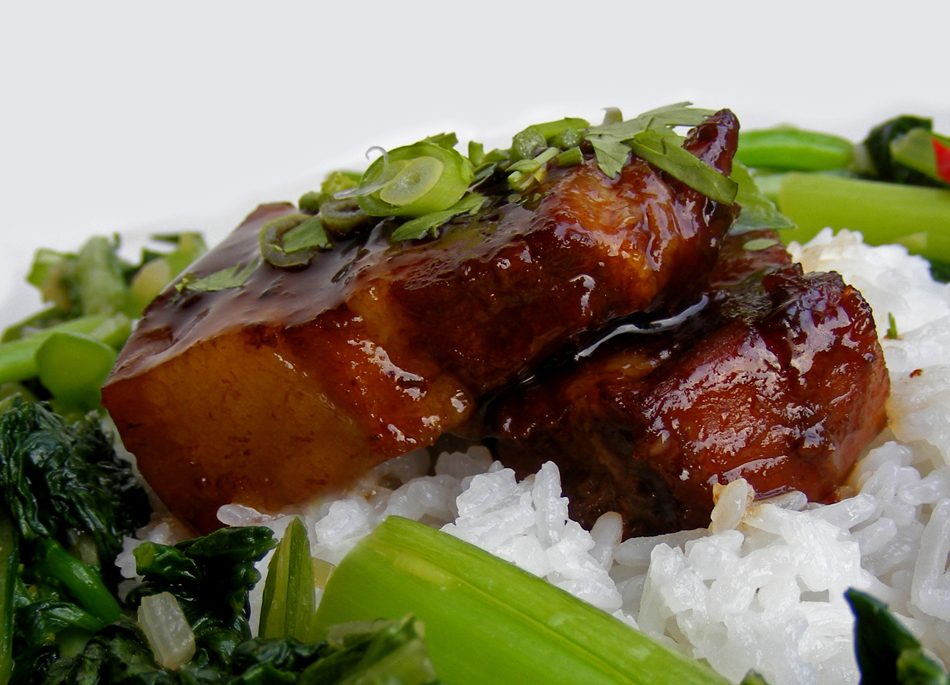
Mao-Style Red-Braised Pork Belly (毛氏红烧肉)
Declassified 22 August 2026
Threat assessment
500 SHUMILD
- 1 No contact Nobody is in danger. Least of all the locals.
- 2 Light resistance A warmth. You mention it. Nobody responds.
- 3 Engaged You are sweating. No one else at the table is sweating.
- 4 Taking fire You have stopped talking. A child has taken your portion.
- 5 Operative down Extraction required. Locals describe this one as "not spicy".
Hongshao rou is cooked all over China, but the Shaoshan version associated with Mao Zedong is the Hunanese one: no soy sauce at all, so every scrap of colour and depth comes from sugar caramelised in the pan, and the seasoning behind it is salt and whole dried chilli. Done properly the skin is glassy and faintly translucent, the fat has collapsed to jelly on the tongue, and the glaze clings to each cube rather than pooling around it. The dish turns on one thing, which is taking the caramel to dark amber and not one shade further, because burnt sugar cannot be rescued once it is in the pot. Everything after that is a very low simmer, a long rest, and a hard reduction at the end. Photo: FotoosVanRobin Photostream (CC BY 2.0), via Wikimedia Commons.
// SUPPLY LIST
SCALE:
| AMT | UNIT | ITEM |
|---|---|---|
| 1 | kg | Pork belly, skin on, single slab 4-5 cm thick with clear alternating layers of fat and lean, cut into even 4 cm cubes |
| 60 | g | Fresh ginger, unpeeled, sliced 3 mm thick (30 g for the blanch, 30 g for the braise) |
| 3 | stalk | Spring onions, white parts only, bruised with the flat of a knife (for the blanch, then discarded) |
| 120 | ml | Shaoxing wine (60 ml for the blanch, 60 ml for deglazing) |
| 45 | g | Yellow rock sugar (冰糖), crushed to pieces no larger than a pea |
| 6 | clove | Garlic cloves, peeled and left whole |
| 2 | piece | Star anise, whole |
| 1 | piece | Cassia bark (桂皮), 5 cm length, or a cinnamon stick |
| 2 | piece | Chinese bay leaves (香叶) |
| 8 | piece | Dried red chillies, Hunan facing-heaven (朝天椒) or similar, left whole and unseeded |
| 800 | ml | Boiling water |
| 12 | g | Fine sea salt, about 2 tsp (8 g into the braise, 4 g held back to adjust the glaze) |
| 2 | stalk | Garlic greens / green garlic (蒜苗), cut into 4 cm lengths |
| 300 | g | Long-grain or jasmine rice, steamed plain, to serve |
// OPERATIONS
- 1 Choose a single slab of skin-on belly 4-5 cm thick with clearly alternating layers of fat and lean, and run your palm over the skin: if you feel bristles, singe them over a gas flame or scrape them off with the back of a knife, because they never soften in the pot and you will find them in the finished glaze. Cut the slab into even 4 cm cubes, keeping skin on every piece — cut them unevenly and the small ones will disintegrate into the sauce during the final reduction — and put them into a 24 cm saucepan with cold water to cover by 3 cm, 30 g of the sliced ginger, the bruised spring onion whites and 60 ml of the Shaoxing wine.
- 2 Bring to a full boil over high heat — 100°C / 212°F, which takes 12-15 minutes for this much cold water and cold meat, not the five you might expect — skimming off the grey-brown foam as it rises, then simmer 3 minutes more until no new foam forms. Starting the pork in cold water is not optional: dropped into boiling water the surface proteins set instantly and the blood coagulates inside the meat instead of being drawn out, which gives a muddy, off-tasting sauce two hours later when it is far too late to fix. Drain and discard the ginger and spring onion, rinse each cube under warm running water — never cold, as the temperature crash contracts the skin and leaves it rubbery — and pat completely dry with kitchen paper, because a wet cube spits violently in the next step and will steam rather than brown.
- 3 Set a 30 cm carbon-steel wok or a heavy 24 cm cast-iron casserole over medium heat with no oil at all, hot enough that a cube hisses on contact (roughly 160-180°C / 320-355°F at the surface), lay the cubes skin-side down in a single layer and render undisturbed for 6-8 minutes until the skin is deep gold and about 3 tbsp of clear fat has pooled, then turn and colour the fatty faces for 3-4 minutes until the edges catch and the cubes look burnished. Do not crowd the pan: cubes that touch each other steam instead of browning and never take the caramel evenly, so work in two batches if your pan is smaller than 30 cm. Lift the pork onto a plate and pour off all but 1 tbsp of the rendered fat, saving the rest for frying vegetables.
- 4 Return that 1 tbsp of fat to the pan over medium-low heat, add the 45 g crushed rock sugar and stir constantly with the back of a ladle: over 4-6 minutes it melts, foams pale straw, then darkens to the colour of dark maple syrup, smells faintly of toffee and throws its first thin thread of smoke. The sugar itself is passing about 170-180°C / 340-355°F at that point, so keep the pan moving but do not baby it — held at a timid 150°C / 300°F the sugar simply sits there wet and pale and will never colour at all. This caramel, tangse (糖色), is the entire colour of the dish, so pull it one shade early rather than one shade late: dark amber turns to acrid black in under 20 seconds, and burnt tangse cannot be diluted or rescued. If it smells sharp or goes the colour of espresso, tip it out, wash the pan and start again.
- 5 The instant the caramel is right, tip in the dried pork and toss hard for 60-90 seconds until every cube is lacquered an even chestnut brown, then add the remaining 30 g sliced ginger, the whole garlic cloves, star anise, cassia bark and bay leaves and stir for 30-45 seconds until they smell warm and nutty and the garlic is just turning pale gold. Add the whole dried chillies last, for the final 10-15 seconds only and towards the cooler edge of the pan: at caramel temperature their skins blacken in well under a minute, and that scorched bitterness never leaves the pot.
- 6 Pour the remaining 60 ml Shaoxing down the hot side of the pan and let it hiss and boil off for 20 seconds, then — if you have been working in a wok — transfer everything to a heavy 22-24 cm casserole or clay pot before adding the 800 ml boiling water. The pot width matters more than it looks: in a 30 cm wok, 800 ml gives barely 2.5 cm of liquid against 4 cm cubes, so the tops sit proud, dry out and stain dark, whereas in a 22-24 cm pot the same water comes up level with the pork, which is exactly what you want. It must be boiling water, too: cold water crashes the pot temperature, the muscle fibres seize, and no amount of extra time will loosen them again. Bring back to a boil, then drop the heat until the surface barely trembles at around 95°C / 203°F, set the lid slightly ajar and cook for 75-90 minutes, because a rolling boil emulsifies the fat into the liquid and leaves you with a cloudy, greasy sauce and shredded meat.
- 7 At the 60-minute mark stir in 8 g of the fine sea salt and taste the braising liquid: with no soy sauce anywhere in this dish, salt is the only savoury seasoning it gets, and 1 kg of pork in 800 ml of water needs a good two teaspoons in total or it drinks as sweet, flat and strangely empty. Hold the last 4 g back until the sauce is reduced, since the liquid loses two-thirds of its volume at the end and anything you add now concentrates with it. Resist the urge to reach for soy sauce: the Shaoshan version takes its colour and depth entirely from the caramel, and soy flattens the sugar and turns a translucent red glaze into a muddy brown one. At 80-90 minutes push a bamboo skewer through a cube — it should pass through skin, fat and meat with no resistance at all, and the skin should look glassy and slightly translucent at the edges.
- 8 Take the pot off the heat, put the lid on properly and rest for 20-30 minutes: the meat reabsorbs the liquid it pushed out during the braise, and the cubes firm up enough to survive the final reduction without collapsing into the sauce. Hunanese home cooks routinely take it to exactly this point a day ahead — cool it, refrigerate overnight, lift off the set fat cap in the morning and carry on from the next step. The dish is genuinely better for it, and the fat lifts off far more cleanly cold than it ever skims off hot.
- 9 Lift the pork out with a slotted spoon, then fish out and discard the star anise, cassia bark, bay leaves and the dried chillies — the chillies have given up all the heat they are going to give, and left in they split and scorch in the hard reduction — and spoon off all but about 2 tbsp of the fat floating on the surface. Boil the remaining liquid hard over high heat at a full 100°C / 212°F for 8-12 minutes until it has reduced to roughly 150 ml, the bubbles have gone large, slow and glossy, and it coats the back of a spoon. Stop there: taken much below 150 ml the sugar tips towards hard-crack and the glaze turns tacky and bitter as it cools. Never reduce with the meat sitting in the pan from the start, either — concentrated sugar against the cubes scorches them and turns the whole sauce bitter at the last hurdle.
- 10 Return the pork to the pan, taste the sauce and stir in the last 4 g of salt if it needs it, then toss over medium heat for 1-2 minutes until every cube is mirror-glazed and the sauce clings rather than pools. Kill the heat, scatter over the garlic greens and toss for 30 seconds in the residual heat so they wilt but stay bright green — put them in over a live flame and they go khaki and sulphurous within a minute. Let it stand 5 minutes off the heat for the glaze to set slightly, then serve straight from the pot with the plain steamed rice, pouring any glaze left in the pan over the rice, and something plain and green alongside such as stir-fried water spinach or blanched choy sum to cut the richness.