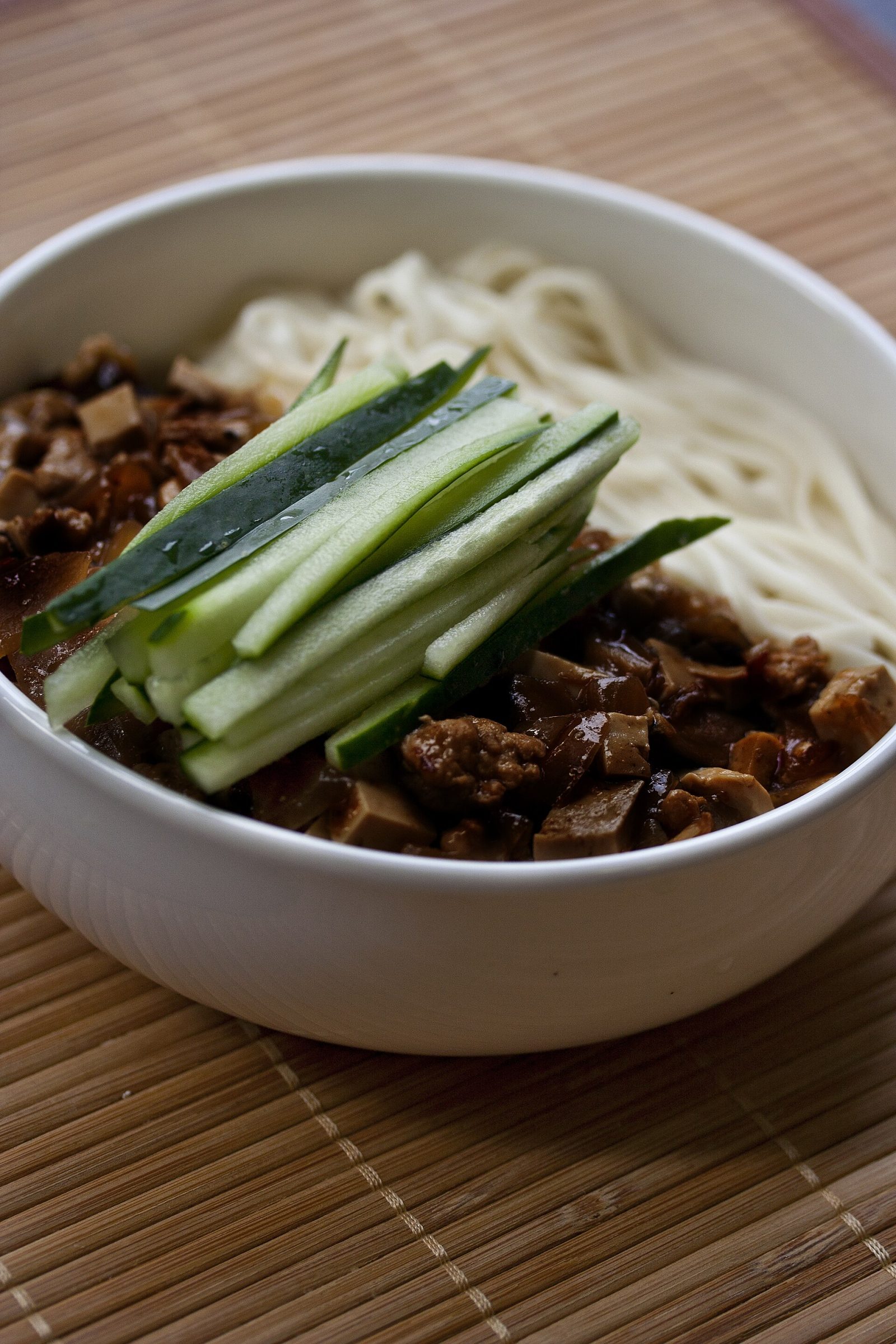
Old Beijing Zhajiangmian (老北京炸酱面)
Declassified 22 August 2026
Threat assessment
- 1 No contact Nobody is in danger. Least of all the locals.
- 2 Light resistance A warmth. You mention it. Nobody responds.
- 3 Engaged You are sweating. No one else at the table is sweating.
- 4 Taking fire You have stopped talking. A child has taken your portion.
- 5 Operative down Extraction required. Locals describe this one as "not spicy".
Zhajiangmian is Beijing's everyday noodle dish: diced pork belly slow-fried in oil with salty dry yellow soybean paste and a smaller amount of sweet flour paste, cooked down until the oil separates and floats on top, then spooned over hand-cut wheat noodles. The classic city version is called xiao wan gan zha — "small-bowl dry-fried" — because the sauce is fried until it is thick and dark rather than left loose and soupy. What separates a good one from a bad one is patience at the pan: forty minutes at a bare simmer turns the raw, sharp, muddy paste into something deep, glossy and almost meaty, and no amount of seasoning afterwards can fake it. It is always eaten with a rack of raw and blanched vegetables called mianma, which cut the salt, and whole raw garlic cloves bitten between mouthfuls. Photo: Archon6812 (CC BY-SA 3.0), via Wikimedia Commons.
// SUPPLY LIST
SCALE:
| AMT | UNIT | ITEM |
|---|---|---|
| 500 | g | Plain wheat flour, 10-11% protein (Chinese zhongjin fen or supermarket all-purpose), for the hand-cut noodles, plus about 60 g extra for dusting the board and the cut noodles |
| 5 | g | Fine sea salt, for the noodle dough |
| 235 | ml | Cold water, for the noodle dough |
| 150 | g | Dry yellow soybean paste (gan huang jiang, ideally Liubiju or Tianyuan) - the thick, dark, very salty kind sold in a tub, not a thin sauce |
| 50 | g | Sweet flour paste (tian mian jiang) |
| 150 | ml | Cold water, for loosening the pastes |
| 350 | g | Pork belly, skin removed, firmed 15 minutes in the freezer then cut into 1 cm dice, keeping the fat and lean roughly half and half |
| 100 | ml | Peanut oil |
| 1 | piece | Star anise, whole |
| 1 | tbsp | Shaoxing wine |
| 15 | g | Ginger, peeled and very finely minced |
| 120 | g | Spring onion whites (Chinese da cong if you can get it), finely diced - half fried into the sauce, half stirred in raw at the end |
| 200 | g | Cucumber, halved lengthways, seeds scraped out, cut into 3 mm julienne |
| 100 | g | Green-heart radish (xin li mei) or daikon, peeled and cut into 3 mm julienne |
| 150 | g | Soybean sprouts, ragged root tips pinched off |
| 100 | g | Celery, strings peeled away, cut into 5 mm dice |
| 80 | g | Shelled green soybeans (edamame), fresh or frozen |
| 6 | clove | Garlic cloves, peeled and left whole, to bite between mouthfuls |
| Chinkiang black vinegar, to splash at the table |
// OPERATIONS
- 1 Make the noodle dough first so it can rest while you cook the sauce: stir the 5 g salt into the 500 g flour in a wide bowl, then trickle in the 235 ml cold water while raking with chopsticks until the flour is in damp, ragged flakes. This is a stiff northern dough at about 47% hydration and it will look far too dry to come together - do not add more water, or the noodles will stretch and turn gummy in the pot instead of cutting clean. Squeeze the flakes into one rough lump, knead for 5 minutes, cover with a damp cloth and leave 30 minutes, then knead again for 3 minutes until the surface is smooth and satiny and cover for a further 30 minutes.
- 2 Loosen the pastes while the dough rests: put the 150 g dry yellow soybean paste and 50 g sweet flour paste in a bowl and whisk in the 150 ml cold water a third at a time with chopsticks until completely smooth and the consistency of double cream, with no lumps and no dry pockets. This step is not optional and cannot be done in the pan - dry paste dropped straight into hot oil scorches on the base within seconds and turns the whole batch bitter and permanently raw-tasting. Taste a smear: it should be aggressively salty and slightly sharp. That 3:1 ratio of salty yellow paste to sweet paste is the Beijing proportion; more sweet paste and you drift towards a Tianjin or northeastern sauce.
- 3 Render the pork gently: put the 350 g diced pork belly, the 100 ml peanut oil and the whole star anise together into a cold 30 cm carbon steel wok or heavy cast iron pan, set over medium-low heat, and bring the oil only to 130-150C / 265-300F - lazily bubbling around the meat, never spitting hard - then fry for 8-10 minutes, stirring every minute. Starting cold is deliberate: it draws the fat out of the belly instead of searing it shut, and it gives the star anise the full ten minutes in warm fat it needs to actually perfume the oil. Let the oil run hotter than this and the lean cubes seize and go hard and stringy before the fat has rendered. It is ready when the fat cubes have turned translucent and shrunk, the lean edges are pale gold, the pieces rattle loose from each other, and the rendered fat in the pan runs clear rather than cloudy. Pour in the 1 tbsp Shaoxing wine around the rim and let it hiss away for 20 seconds.
- 4 Fish out the star anise and discard it - left in for the long fry it turns medicinal and dominates everything. Add the 15 g minced ginger and 60 g of the diced spring onion whites (half the total) and fry for 60-90 seconds, until the onion is limp and smells sweet rather than raw and the ginger no longer smells green.
- 5 Turn the heat to low, stand back, and pour in the loosened paste all at once - it will spit violently for the first 15 seconds as the water hits the hot fat, so use a lid as a shield and stir immediately with a long wooden spoon to bring the whole pan to one texture. Scrape the base thoroughly as you stir; anything left stuck there will burn and thread bitterness through the entire batch.
- 6 Now fry the sauce for 35-45 minutes over low heat, held at a bare simmer around 100-105C / 212-220F where a single lazy bubble breaks the surface every second or two, stirring for 15 seconds every 2-3 minutes and always scraping the base and the corners. In the last ten minutes, as the water finally cooks off, the pan will climb past 110C / 230F and the sound changes from a wet blup to a fine sizzle - that is the sauce stopping simmering and genuinely beginning to fry in its own fat, and it is the whole point of the exercise. There is no shortcut: on high heat the paste catches underneath and the sauce tastes scorched and simultaneously raw, and 20 minutes simply is not enough to cook out the sharp fermented edge. Add no salt and no soy sauce at any point - the paste carries all of it.
- 7 Judge doneness by sight, not the clock. At 15 minutes the sauce is still muddy brown, loose and slack; by 30 minutes the bubbles have turned slow and glossy and it has darkened noticeably. It is done when a distinct 3-5 mm layer of clear amber-brown oil has separated and pooled on the surface and around the rim, the sauce beneath has gone deep chestnut-black and glossy, the volume has dropped by about a third, and a spoonful dropped back into the pan falls as one heavy mass instead of running. That separated oil is the sign the Beijing cooks look for - do not skim it off, it is what carries the flavour onto the noodles.
- 8 Take the pan off the heat, stir in the remaining 60 g of raw diced spring onion white, and leave the sauce to stand for 10 minutes. The residual heat wilts the onion just enough to soften its bite while keeping it fresh and green-tasting against the dark sauce. You should have roughly 500 ml of finished zhajiang. At the 3-4 tablespoons per bowl this sauce is meant to be eaten at, four bowls will use only about half of it - the batch is deliberately generous, because zhajiang is made to be kept and improves for days.
- 9 Prepare the mianma while the sauce rests. Bring a small pan of water to the boil and blanch each vegetable separately, plunging each straight into cold water afterwards: the 80 g green soybeans for 4-5 minutes until they squash easily between finger and thumb with no starchy core, the 150 g soybean sprouts for 90 seconds until they lose their squeak but keep their snap, and the 100 g diced celery for 45 seconds until it brightens and turns faintly translucent at the edges but still cracks when bitten. Leave the 200 g julienned cucumber and 100 g julienned radish completely raw - they are the cold, crunchy counterweight to a salty sauce and blanching them ruins the dish. Drain everything well and set each vegetable in its own small bowl alongside the whole garlic cloves.
- 10 Roll and cut the noodles: divide the rested dough in two, keeping the second half covered, and roll the first piece out on a well-floured board to an even 2 mm sheet, turning and re-flouring often. Dust the sheet generously with the extra flour, fold it back and forth into a flat accordion about 8 cm wide, and cut straight down through the stack with a heavy knife into 3 mm ribbons. Shake the cut noodles loose immediately and toss them with more flour - under-dusted noodles weld into a solid brick in the pot and there is no rescuing them. Repeat with the second piece.
- 11 Bring 5 litres of water to a hard rolling boil in a large pot and add no salt (the dough is already salted); anything less than 5 litres and the pot goes starchy and sluggish under this much fresh noodle and the strands turn slimy. Shake the excess flour off the noodles, drop them in, and stir once to separate. When the water returns to a full boil, pour in 100 ml of cold water to knock it back, and repeat this twice more - the traditional dian shui, which cooks the noodle through to the centre without the outside going slack. Total time is 3-4 minutes; test by pinching a strand in half, and pull them the moment no chalky white core remains.
- 12 Warm the sauce through over low heat for 2-3 minutes if it has gone cold while you cut the noodles - cold zhajiang sits on the strands in stiff lumps instead of streaking through them - then serve at once, Beijing-style: in warm weather rinse the drained noodles in cold water and shake them dry so they are cool and springy, and in cold weather lift them straight from the pot into the bowl. Give each person a bowl of noodles topped with only 3-4 tablespoons of the sauce - it is intensely salty and concentrated, and drowning the noodles is the single most common mistake at home - then let everyone pile on their own mianma, toss the bowl hard until every strand is streaked brown, and eat with a splash of black vinegar and a whole raw garlic clove bitten between mouthfuls. The leftover sauce keeps 2 weeks in the fridge in a jar under its own cap of oil, and is better on day three than on day one.