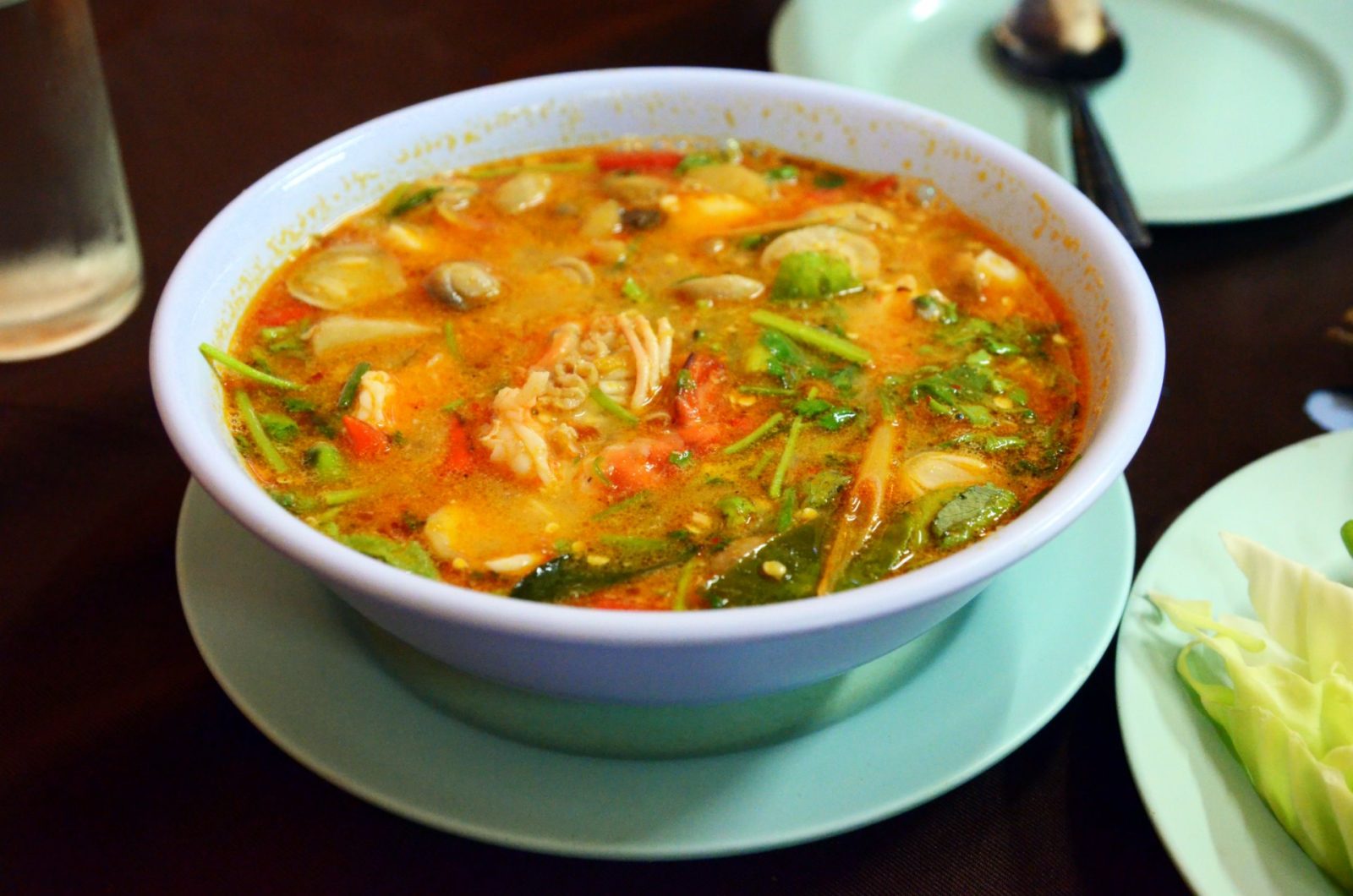
Tom Yam Kung (ต้มยำกุ้ง) — Hot and Sour Prawn Soup
Declassified 22 August 2026
Threat assessment
3,500 SHUMEDIUM
- 1 No contact Nobody is in danger. Least of all the locals.
- 2 Light resistance A warmth. You mention it. Nobody responds.
- 3 Engaged You are sweating. No one else at the table is sweating.
- 4 Taking fire You have stopped talking. A child has taken your portion.
- 5 Operative down Extraction required. Locals describe this one as "not spicy".
Tom yam kung is the hot-and-sour prawn soup of Central Thailand, built on a fast stock made from prawn heads and shells and perfumed with bruised lemongrass, sliced galangal and torn makrut lime leaf. This is the tom yam nam khon version, rounded with nam phrik phao (roasted chilli paste), a measure of evaporated milk and the orange fat squeezed from the prawn heads, which together give a good bowl its burnt-orange colour and its body. A good one tastes sour first, salty second, with the chilli heat blooming a beat later and the aromatics sitting over the top; it should never taste sweet, and the broth should be fragrant rather than muddy. Everything that matters happens in the last few minutes, off the heat, where the fish sauce, lime and milk go in. Photo: Takeaway (CC BY-SA 3.0), via Wikimedia Commons.
// SUPPLY LIST
SCALE:
| AMT | UNIT | ITEM |
|---|---|---|
| 500 | g | Whole raw prawns, head-on and shell-on, about 12-16 (heads and shells reserved for the stock) |
| 1 | tbsp | Neutral oil, such as rice bran or sunflower |
| 1.2 | l | Water, for the prawn stock |
| 3 | stalk | Lemongrass, tough outer layers stripped, bruised along the length and cut on a steep diagonal into 4 cm lengths |
| 40 | g | Galangal, young if possible, peeled and cut into 2-3 mm coins (not ginger) |
| 8 | Makrut lime leaves, central rib pulled out, each leaf torn into 3-4 pieces | |
| 3 | Asian shallots, peeled and lightly crushed with the flat of a knife | |
| 150 | g | Straw mushrooms, drained and halved through the stem (fresh oyster mushrooms torn into strips are the accepted home substitute) |
| 8 | Cherry tomatoes, halved | |
| 8 | Bird's eye chillies (prik kee noo), stems on, lightly crushed with the flat of a knife | |
| 2 | tbsp | Nam phrik phao (Thai roasted chilli paste in oil) |
| 1 | tsp | Palm sugar, shaved from the disc |
| 3 | tbsp | Fish sauce, good quality |
| 60 | ml | Lime juice, squeezed at the last moment |
| 60 | ml | Evaporated milk, unsweetened, for the nam khon finish |
| 15 | g | Coriander leaves and fine stems, roughly chopped |
// OPERATIONS
- 1 Pull the heads off the prawns into a small bowl, then peel the bodies, leaving the final tail segment attached, and lift out the dark intestinal tract through a shallow cut down the back. Squeeze each head hard over the bowl so the loose orange fat (mun kung) runs out, then reserve that fat separately, keep the heads and shells for the stock, and refrigerate the peeled bodies. The head fat is not a garnish - it is where most of the colour, body and prawn flavour of the finished soup comes from, so nothing here goes in the bin.
- 2 Heat 1 tbsp oil in a 3-4 litre heavy-based saucepan over medium-high heat until it shimmers, add all the heads and shells, and press and stir them with the back of a ladle for 3-4 minutes, until the shells turn bright coral, the oil stains deep orange and the kitchen smells toasted rather than raw. Keep the pan moving and pull back to medium if you see any brown-black patches on the shells - scorched prawn heads turn the whole stock bitter and there is no fixing it later.
- 3 Pour in 1.2 litres of water, bring it up to a bare simmer at around 95C / 203F where the surface only trembles, and cook uncovered for 20 minutes, skimming off the grey foam in the first five minutes. Do not let it roll at a full boil: hard boiling emulsifies the shell proteins and prawn fat into the water and gives you a cloudy, muddy-tasting broth instead of a clean, sweet one.
- 4 While that stock simmers, prepare the aromatics: bruise the lemongrass along its length with a pestle or the flat of a heavy knife until it splinters and smells sharply citrus, slice the galangal into thin coins, crush the shallots just until they crack open but still hold together, and tear the makrut leaves rather than shredding them so the oil in the leaf ruptures out. Do not substitute ginger for the galangal - ginger is warm, sweet and fibrous where galangal is piney and almost camphorous, and the swap makes a decent soup that is simply no longer tom yam.
- 5 Strain the stock through a fine sieve into a bowl, pressing the shells firmly with the ladle to drive out every drop, and discard the solids. You should have about 1 litre; if you have noticeably less, top up with water, and if you have much more, return it to the pan and reduce it to 1 litre so the seasoning quantities below still land.
- 6 Return the strained stock to the rinsed pan, bring it back to a gentle simmer at 95C / 203F, and add the lemongrass, galangal, crushed shallots and half the torn makrut leaves. Simmer for 5-7 minutes only, until the broth smells clearly of lemongrass and lime leaf from arm's length - push the infusion much past ten minutes and the lemongrass turns woody and faintly soapy, and the galangal goes harsh.
- 7 Add the straw mushrooms, cherry tomatoes and the crushed bird's eye chillies and simmer for 2-3 minutes, until the mushrooms have darkened slightly and sunk and the tomato skins have just split at the cut edge but the halves still hold their shape. The chillies need these few minutes in hot broth to give up their heat, but stop while the tomatoes are still intact - once they collapse into pulp the broth goes cloudy and turns faintly jammy, and you lose the clean sour edge.
- 8 Add the peeled prawns and all the reserved head fat, stir once, and cook for 90 seconds to 2 minutes, until the prawns are opaque all through and curled into a loose C. A prawn curled into a tight O is already overcooked and will be rubbery in the bowl, so start checking at 60 seconds and take the pan off the heat the moment the last grey translucency goes.
- 9 Take the pan completely off the heat. Slacken the nam phrik phao with a ladleful of the hot broth in a small bowl until it is smooth and pourable, then stir it back into the pan along with the palm sugar, the fish sauce and the remaining torn makrut leaves. Slackening it first matters - dropped in as a lump, the paste sits on the bottom and the broth ends up oily on top and under-seasoned underneath.
- 10 Let the pan sit for one minute so the broth drops to about 85C / 185F, then stir in the lime juice, taste, and adjust with lime for sourness or fish sauce for salt until it reads sour first, salty just behind, with the chilli heat arriving last. Lime juice must never be boiled or added to a simmering pot: heat drives off its volatile top notes in seconds and leaves a flat, faintly bitter sourness that no amount of extra lime will bring back.
- 11 Still off the heat, pour in the evaporated milk in a thin stream while stirring, until the broth turns from translucent red to an opaque burnt-orange and coats the back of the ladle very lightly. The pan must not be simmering when the milk goes in - against live heat and this much lime the milk splits and the soup separates into a thin broth under a slick of orange oil, which cannot be stirred back together.
- 12 Rest the soup for 2-3 minutes so the aromatics settle and the seasoning marries, then ladle into bowls, making sure each gets prawns, mushrooms and a share of the lemongrass and galangal, and scatter the coriander over at the table. Serve hot with plain jasmine rice, extra lime wedges and a saucer of prik nam pla alongside, and tell people the lemongrass, galangal and lime leaf are there to be pushed aside, not eaten.