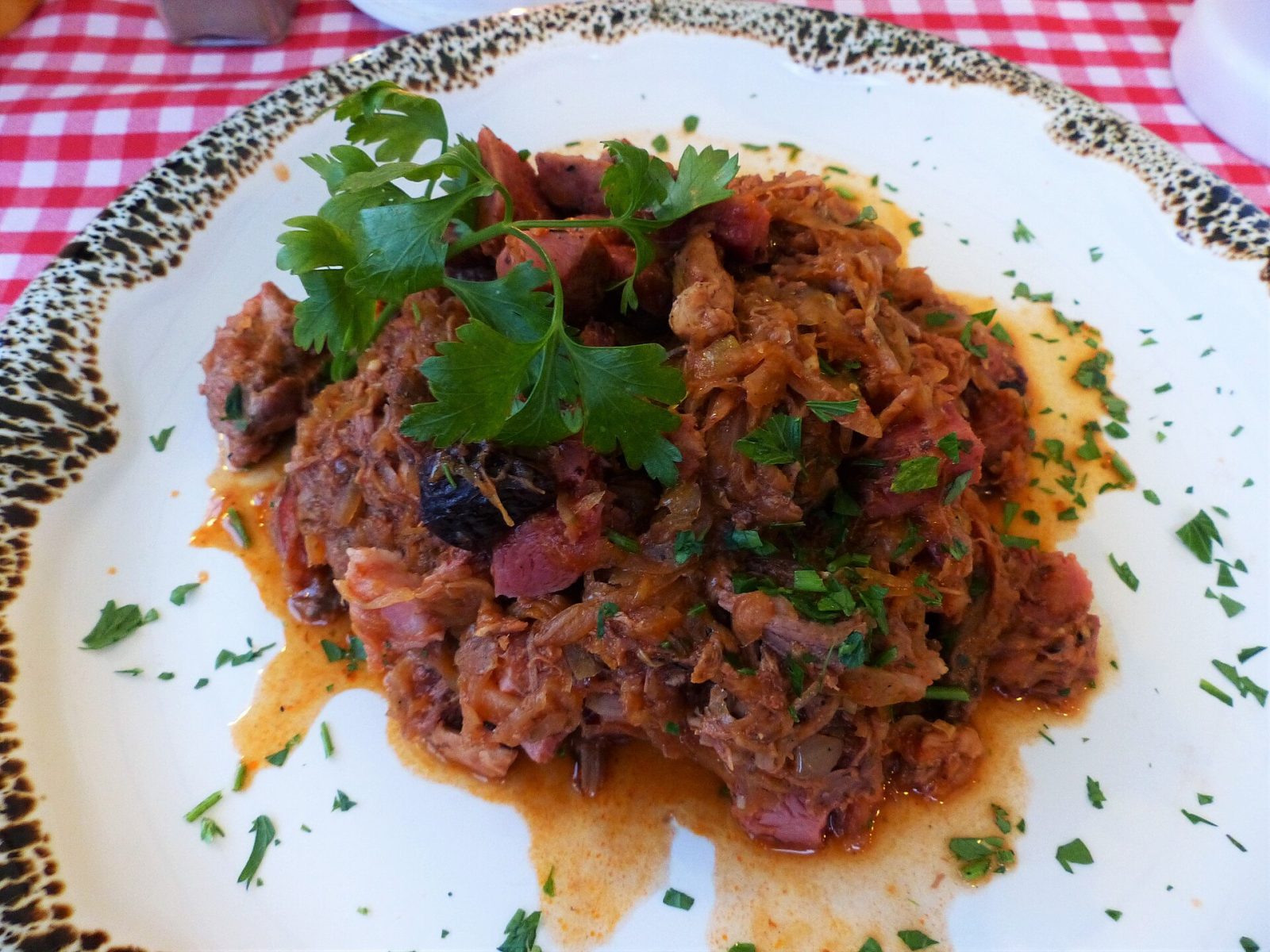
Bigos (Hunter's Stew)
Declassified 22 August 2026
Threat assessment
- 1 No contact Nobody is in danger. Least of all the locals.
- 2 Light resistance A warmth. You mention it. Nobody responds.
- 3 Engaged You are sweating. No one else at the table is sweating.
- 4 Taking fire You have stopped talking. A child has taken your portion.
- 5 Operative down Extraction required. Locals describe this one as "not spicy".
Bigos is a long braise of sauerkraut and fresh cabbage with several kinds of meat, dried forest mushrooms and prunes, cooked and cooled over three days so the sour, the smoke and the fat fuse into something no single-day stew can imitate. It belongs to the whole country, but its logic is the hunting kitchens of the eastern forests, where whatever came home from the shoot went into the pot with the winter cabbage. A good one is dark khaki-brown rather than red, tastes distinctly sour before it tastes of anything else, and is barely wet, the liquid clinging to the cabbage rather than pooling around it. A bad one is a pale, watery cabbage soup with sausage in it, which is what you get when the cabbage is under-cooked and the pot is never cooled and re-boiled. Photo: Dr. Bernd Gross (CC BY-SA 4.0), via Wikimedia Commons.
// SUPPLY LIST
SCALE:
| AMT | UNIT | ITEM |
|---|---|---|
| 40 | g | Dried porcini mushrooms (borowiki), whole caps and stems |
| 1.5 | kg | Sauerkraut (kiszona kapusta), 150 ml of its brine reserved before draining, strands chopped to 3-4 cm |
| 800 | g | White cabbage, cored and shredded 5 mm thick |
| 3 | tbsp | Lard (smalec), or bacon dripping |
| 250 | g | Smoked streaky bacon (boczek wędzony), rind removed, cut into 1 cm lardons |
| 800 | g | Pork shoulder, well marbled, cut into 4 cm cubes |
| 400 | g | Beef shin or venison shoulder, sinew trimmed, cut into 3 cm cubes |
| 400 | g | Polish smoked sausage (kiełbasa wiejska or myśliwska), cut into 1.5 cm slices |
| 500 | g | Onions, halved and finely sliced |
| 2 | tbsp | Tomato purée, double concentrate |
| 250 | ml | Dry red wine, something tannic and unoaked |
| 500 | g | Smoked ham hock or smoked pork ribs, bone in |
| 4 | Bay leaves | |
| 10 | Allspice berries, whole | |
| 12 | Juniper berries, lightly crushed with the flat of a knife | |
| 1 | tsp | Black peppercorns, coarsely crushed |
| 1 | tsp | Caraway seeds |
| 150 | g | Prunes, pitted, preferably smoked (śliwki wędzone), left whole |
| 2 | tbsp | Dried marjoram, rubbed between the palms as it goes in |
| 1 | tbsp | Honey, buckwheat if you have it |
| 3 | tbsp | Plum brandy (śliwowica) or plain vodka, for finishing |
| Fine salt, 1 tsp for the fresh cabbage water and the rest for final seasoning on day three |
// OPERATIONS
- 1 Put the dried porcini in a heatproof bowl, pour over 500 ml of just-boiled water, cover with a plate and leave 45 minutes, until the caps are floppy right through and the liquid is the colour of strong tea. Lift the mushrooms out, squeeze them back over the bowl, chop them to roughly 1 cm, then decant the soaking liquid into a jug and stop pouring the moment you reach the silt in the last centimetre. Never discard that liquid, because it carries most of the forest flavour of the dish, and never tip in the silt, which is grit you cannot cook out. Do the rest of your chopping while the mushrooms soak.
- 2 Before you drain the sauerkraut, ladle 150 ml of its brine into a jar and put it in the fridge for day three; once the kraut has been drained or rinsed that brine is gone for good, and it is your only way to correct the sourness at the end. Now drain the kraut and taste it raw: it should be sharply sour and clean, and only if it is so aggressive it makes you wince should you rinse it once, briefly, under cold running water, because the sour is the dish and a rinsed-out bigos is just cabbage stew. Squeeze it dry, chop the strands to 3-4 cm so they are not stringy on the fork, then put them in a 5 litre pan with all the decanted mushroom liquid and 300 ml water and simmer, covered, over medium heat for 45 minutes, until a strand pulled out and bitten has no crunch left at its core and only a shallow puddle of liquid is left in the base.
- 3 At the same time put the shredded fresh cabbage in a 4 litre pan with 400 ml water and 1 tsp salt and simmer, covered, over medium heat for 25 minutes, until it is translucent and limp but the shreds still hold their shape, then drain it well and press out the water. Cooking the two cabbages in separate pans is standard practice in Polish home kitchens and is not fussiness: acid stops vegetable pectin dissolving, so fresh shreds dropped straight into sauerkraut will stay squeaky for the whole three days no matter how long you braise them.
- 4 Warm 1 tbsp of the lard in an 8-10 litre heavy cast-iron or enamelled casserole, at least 30 cm across, over medium heat and render the bacon lardons for 8-10 minutes, stirring occasionally, until the fat has run and the edges are gold but not crisp; lift them out with a slotted spoon. Turn the heat to medium-high and brown the pork shoulder and the beef shin in the bacon fat in three separate batches, 6-8 minutes each, laying the cubes in a single layer with a finger's gap between them and turning them only when they release easily. Crowding the pan is the commonest way this dish is spoiled: the pot temperature crashes, the meat weeps and turns grey, and you lose the fond on the base that is the difference between bigos and boiled cabbage.
- 5 Brown half the sliced kiełbasa (200 g) in the same fat over medium-high heat, about 2 minutes per side, until the cut faces are mottled dark and the fat has started to run, then set it aside with the meat. Keep the other 200 g unbrowned in the fridge for day two, so that some of the sausage melts into the pot and some still has bite at the table.
- 6 Add the remaining 2 tbsp lard and all the onions, drop the heat to medium-low, and cook 18-20 minutes, stirring and scraping, until they have collapsed to a deep gold, jammy mass and the fond has dissolved off the base into them. Stir in the tomato purée and fry it for a full 2 minutes, until it darkens to brick red and smells sweet rather than tinny; skipping this leaves a raw tomato tang that never cooks out. Tomato purée is a twentieth-century arrival that is now near-universal in Polish home bigos, rounding the acid and deepening the colour, but it can be left out for a strictly old-style pot.
- 7 Pour in the red wine, bring it to a boil and let it bubble hard for 5 minutes, scraping the base with a wooden spoon, until it has reduced by about half and the harsh alcohol smell at the edge of the pan has gone. Wine added later, or not reduced now, leaves a thin sharpness that sits on top of the sourness instead of under it.
- 8 Preheat the oven to 150°C / 300°F. Return the bacon, browned meats, browned sausage and all their juices to the casserole, then add the sauerkraut together with every drop of its mushroom-scented cooking liquid, the drained fresh cabbage, the chopped mushrooms, the bay leaves, allspice, juniper, crushed peppercorns and caraway, and bury the smoked hock in the middle. Do not salt yet: the kraut, bacon, sausage and hock are all salted, and bigos seasoned on day one is inedible by day three once it has reduced twice. The liquid should sit about halfway up the solids and no higher, because the cabbage still has water to give and a pot flooded now will never reduce to the tight, glossy stew you want; add water only if it is drier than that.
- 9 Bring the pot to a bare simmer on the hob, cover, and transfer it to the oven for 3 hours, stirring up from the base every 45 minutes. It is ready for the first rest when the pork shoulder falls apart under side pressure from a spoon, the cabbage has gone from pale to khaki-brown, and a slick of clear fat sits on the surface. If you cook it on the hob instead, use the lowest flame and a heat diffuser and stir every 20 minutes without fail, because once the base catches, the burnt taste runs through all five kilos and nothing removes it.
- 10 Lift out the hock, let it cool 10 minutes, then pull the meat off in shreds and return it to the pot, discarding the bone, skin and any rubbery gristle. Take the pot off the heat and leave it uncovered on a trivet until it has stopped steaming and is no longer warm to the back of the hand, about 2 hours and no longer, then refrigerate overnight, at least 12 hours. This cooling is the technique, not a scheduling convenience: the fat sets and re-emulsifies, the cabbage relaxes and drinks the braising liquid back in, and skipping it gives you a thinner, flatter, more obviously vinegary stew.
- 11 The next day, add the reserved unbrowned sausage and the prunes, bring the pot back to a bare simmer over medium-low heat, 10-15 minutes, stirring often to loosen the set base before it scorches, then cook partly covered for 90 minutes, stirring up from the bottom every 20 minutes. The prunes should still be recognisable but slumped, and the whole pot should smell more of smoke and less of vinegar than it did yesterday. Cool it uncovered again as before and refrigerate a second night.
- 12 On the third day, simmer uncovered over medium-low heat for a final 60 minutes, stirring every 15 minutes, until the bigos is glossy and barely wet: a spoon dragged across the base should leave a channel that fills back slowly rather than instantly. Only now season it. Stir in the honey, then taste and adjust with the reserved sauerkraut brine a tablespoon at a time until the sourness is bright and forward, and add salt last, which will probably be no more than 1-2 tsp. Add the marjoram, rubbed between your palms, in the final 10 minutes so it stays aromatic instead of turning dusty and hay-like.
- 13 Take the pot off the heat, stir in the plum brandy, cover and rest 30 minutes so the raw alcohol blows off and the fat settles back into the cabbage rather than sitting on top. Serve in shallow bowls with dense sour rye bread (chleb żytni na zakwasie) and small boiled potatoes, or with nothing but bread and a chilled glass of żubrówka or plain vodka, which is how it is eaten after a shoot. It keeps in the fridge for a week, improving until about day five, and freezes well in portions; reheat gently from frozen with a splash of water so the cabbage does not catch.